Our History
A Lodge is not born of a date alone. It is born of the people who decide to build something that endures.
Get to know the history of A∴R∴L∴S∴ Fênix nº 1884 — its origin, its homes, its Brethren, and the moments that helped shape its identity.
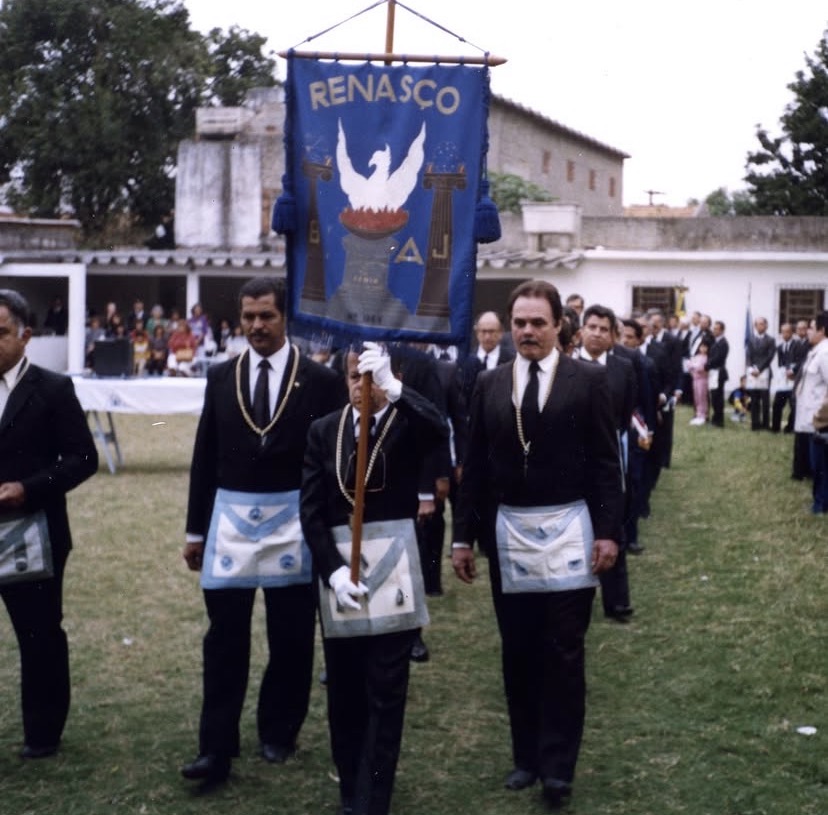
No Lodge begins with itself.
The Fênix is the most recent link in a chain that stretches from the earliest Grand Lodges to the columns we raise today in Cascadura.
The chain
- 1717
Founding of the Grand Lodge of London
Four Lodges meet and found the first Grand Lodge. It marks the passage of Freemasonry from operative — the stonemasons' guilds — to speculative, the Craft of ideas.
- 1723
Anderson's Constitutions
Establishes that masons be good and true men, whatever their beliefs might be, making the Order a Center of Union among men who would otherwise have remained separate.
- 1737
The Chevalier Ramsay's Oration
In France, Ramsay gives Freemasonry a historical and mythical narrative that raises its prestige and opens the way for the higher degrees.
- 1801
The Ancient and Accepted Scottish Rite
Originating in Scotland and born in France, the Rite is organized in the United States into thirty-three degrees. It is the Rite we practice.
- 1813
United Grand Lodge of England
The two rival English Grand Lodges unite. From that union comes the standard of regularity that still governs recognition between jurisdictions worldwide.
- 1822
Grande Oriente do Brasil
On June 17, on the eve of Brazil's Independence, Lojas Comércio e Artes na Idade do Ouro, União, and Tranquilidade e Esperança de Niterói found the first Brazilian Masonic Power.
Our House
- 1973
Founding of Loja Fênix
July 30, 1973
Meeting several times at the townhouse on Rua Domingos Lopes, in Madureira, a group of Brothers tries to revive the columns of Loja Mascarenhas de Moraes, which had gone dormant, having been frequented mostly by military members passing through. Unable to reactivate it, they decide the effort will not be lost: they raise a new Lodge, and give it the name of the bird that remakes itself from its own fire. The first Worshipful Master is Bro∴ Victor Wein.
- 1973
Installation
December 15, 1973
The Lodge is installed in the presence of the Order's Sovereign Grand Master, and begins to work regularly.
- 1973
The first home
Madureira
For about nine years the Fênix works at the Temple of Loja Deus e Universo, on Rua Domingos Lopes, 833 — the same house where the founders had first met.
- 1982
Quintino
The Lodge moves to the Temple of Loja Marquês do Herval, on Rua Olina, 21, keeping its work always on Mondays — and nursing the wish for a home of its own.
- 1986
Legal personality
January 16, 1986
With its bylaws approved by the Grande Oriente do Brasil and by the Grande Oriente do Estado do Rio de Janeiro, the Lodge is registered with the RCPJ (the Brazilian civil registry of legal entities).
- 1986
The Cascadura ground
July 7, 1986
The Lodge acquires the land at Rua Palatinado, 380 — twenty meters of frontage and depth, by forty-four on each side. For the first time, a ground of its own.
- 1990
The cornerstone
July 29, 1990
The Brethren gather around the laid stone, at the center of the plot. There begins the work that would only be finished sixteen years later.
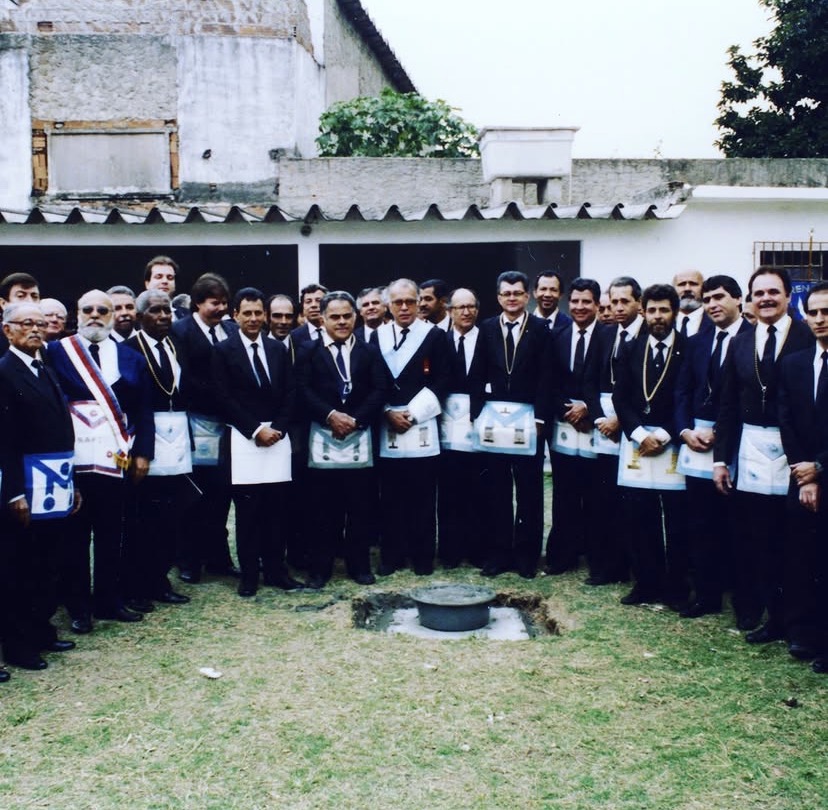
The Brethren around the cornerstone, July 29, 1990. - 1993
The first slab
At twenty years old, the building goes from foundations to its first slab, under the technical responsibility of Bro∴ José de Brito Amorim, civil engineer and member of the Lodge.
- 1998
Benefactress of the Order
At twenty-five years of uninterrupted work, the Lodge receives from the Grande Oriente do Brasil the title of Benefactress of the Order.
- 2006
Consecration of the Temple
July 30, 2006
Thirty-three years after its founding, on that same July 30, the Temple is consecrated. The Lodge begins its labors at the Palácio Maçônico de Cascadura.
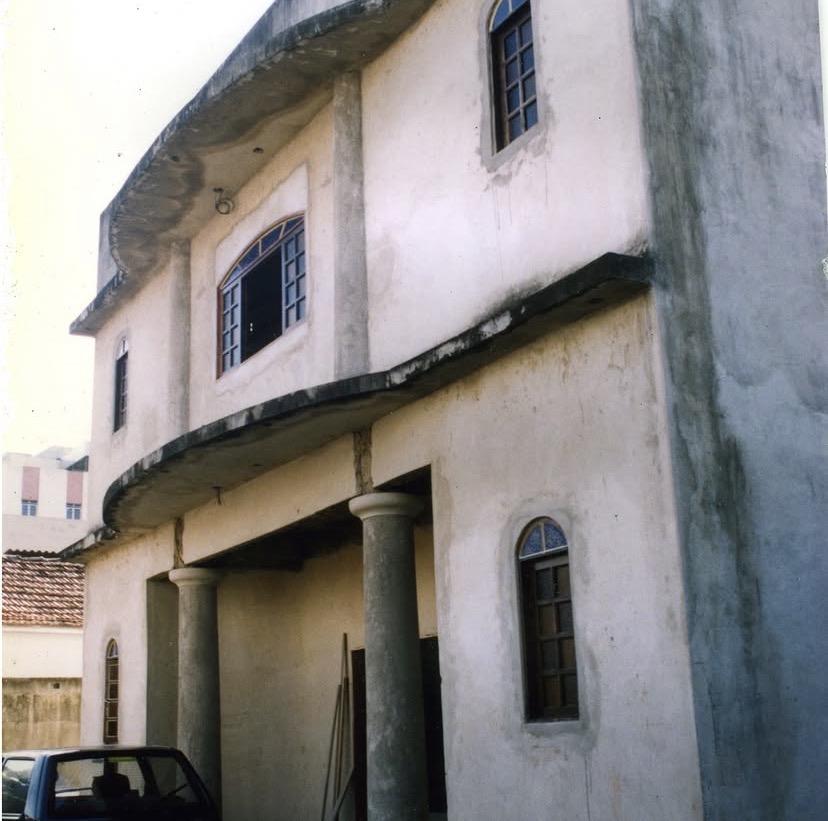
The facade, with its columns and arches already raised. - 2023
Grand Benefactress of the Order
On turning fifty, the Lodge is elevated to Grand Benefactress of the Order — the title it now carries in its own name.
- Today
The chain continues
And the next link belongs to whoever arrives now.
The milestones from 1973 to 1993 come from Parabéns Fênix, written by Bro∴ José Eduardo Carneiro on August 2, 1993, and published in the book A Fênix e o Aprendiz, given to every initiated Brother.
Seventeen names and a date.
These are the Brothers who met at the townhouse in Madureira and finally reached the day of July 30, 1973. Leading them, as preceptor, the Lodge's godfather.
- Victor WeinGodfather and first Worshipful Master, 1973–1977
- Jair Valente de Avilez
- Newton José Saturnino Vianna
- Mizael Cruz
- Agenor Ferreira da Silva
- Octacílio Queiroz de Souza
- Eurico Luiz Pereira
- Sebastião Ferreira da Silva
- Kleber Paul Nery
- Ricardo Bath Crespo
- Euclides Manoel Leite
- Antônio Vieira de Rezende
- Hiram Nunes
- Jairo Gonçalves Vieira
- Daniel Antônio Teixeira
- Enoc Teixeira Wenceslau
- Francisco Pereira Malafaia
Archive noteThe list follows the order of the 1993 record, not an order of precedence. The full succession of Worshipful Masters is not published here: it lives in the Members Area, alongside the organizational chart and the Roll of the Eternal Orient.
To build the long-dreamed inner temple, through the tireless work of shaping the rough ashlar, is what Loja Fênix wishes for all its beloved sons to achieve.
The photographs that follow show concrete, formwork timber, brick, and plaster. But the work site Freemasonry speaks of is not only that one. When these lines were written, the building on Rua Palatinado was still at its first slab.
That is why the Order kept the language of the building sites after it stopped building cathedrals. Plumb, square, ruler, and gavel remain the tools — only the stone has changed. One of these works took sixteen years. The other never ends.
Where the history took shape
Before becoming a place of gathering, study, and fellowship, this site was also a construction project — a collective undertaking. In the photographs there is wooden formwork, exposed rebar, bare brick — and, in several of them, the Brothers themselves with their families.
Archive noteThe construction photographs have no individually recorded date. What is dated is the cornerstone, July 29, 1990, and the consecration of the Temple, July 30, 2006 — the building work falls between the two. More precise dates and captions will be added as the Lodge provides them.
The same place, two eras.
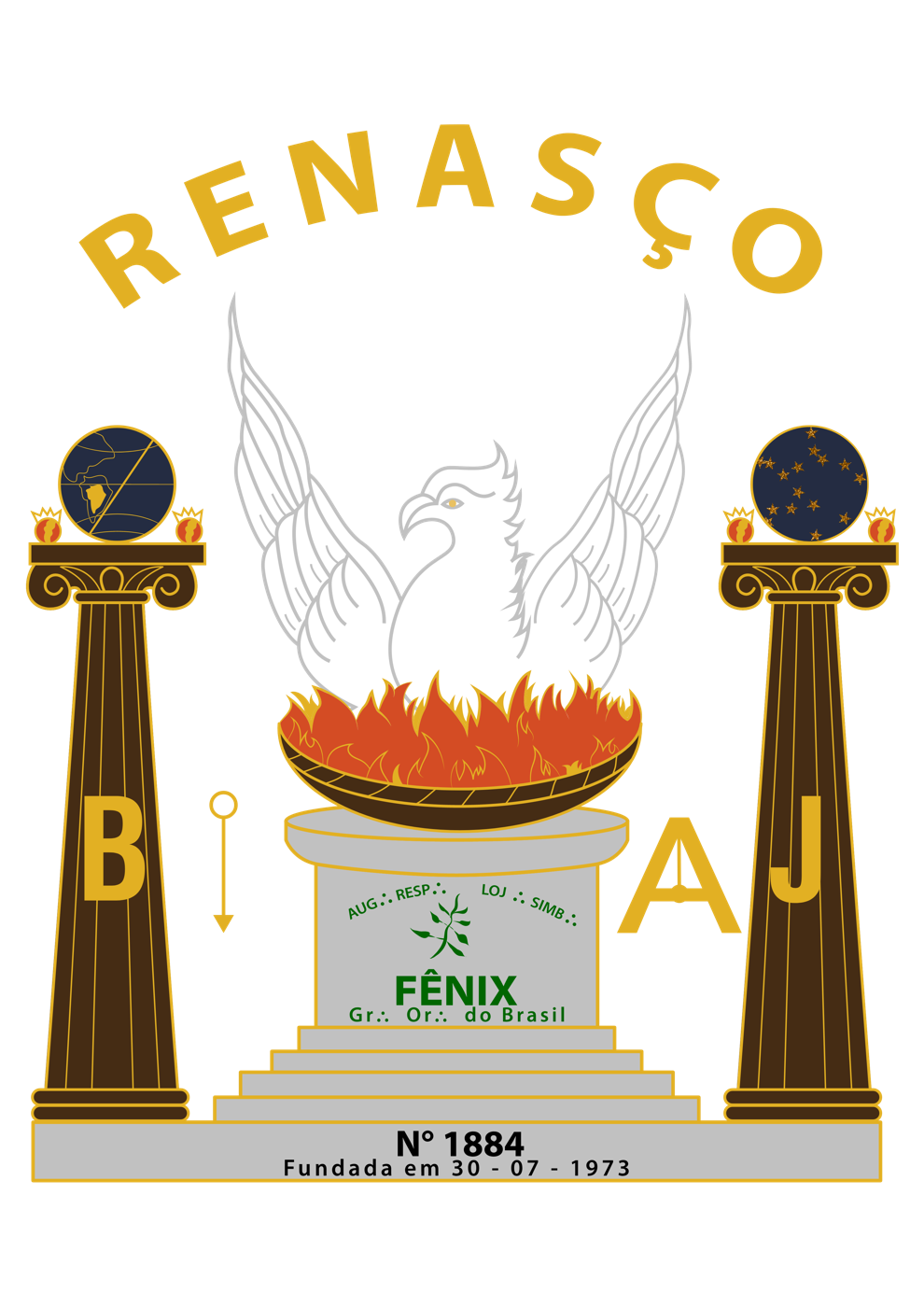
The Standard
It is in this standard that the Lodge says who it is, without a single line of explanation. Every element has a function, and none is there for ornament.
- Renasço
- The motto, arched at the top. A verb in the first person, present tense — the grammatical choice is itself the meaning: “I rise anew.”
- The Phoenix
- White, wings open, rising from the lit brazier. The bird that remakes itself from its own fire gives the Lodge its name.
- The columns B∴ and J∴
- The two columns of the Temple's porch, with lit embers on their capitals, topped by the terrestrial globe and the celestial globe.
- The altar and the acacia
- Stepped, with the sprig of acacia in green and the inscription Aug∴ Resp∴ Loj∴ Simb∴ Fênix · Gr∴ Or∴ do Brasil.
- The base
- Nº 1884 · Founded 07-30-1973. The 1884 is the Lodge's registration number with the Grande Oriente do Brasil — not the year it was founded.
Phenix, as it stands in the founding charter.
The name was not chosen by chance. From the Latin Phoenix, from the Greek Phoínix, it designates in Egyptian legend the solitary bird that, at the end of a long cycle, builds itself a nest, exposes itself to the sun until fire comes, fans it with its own wings, and rises again from the ashes.
Hence its being a symbol of the alternation between activity and rest, of rebirth and transmutation — the same figure that occupies the center of the standard, above the brazier, wrapped in flames, as a reminder that the Mason, too, can rise anew from his own ashes.
My life to fire and iron I can give, and lose it in whatever hardship comes, and in it, like the Phoenix, be renewed.
The archive remains open.
Photographs, documents, and dates not yet included here can be delivered to the Secretary. Every piece received is recorded and becomes part of this page.
Talk to the Secretary →